Different rules
YouTube, TikTok and Instagram expose different APIs, handoffs, limits and success signals.
Independent product / Media operations
I designed and built Clip Forge as an observable media-operations product spanning sourcing, rendering, publishing, verification, analytics and recovery.
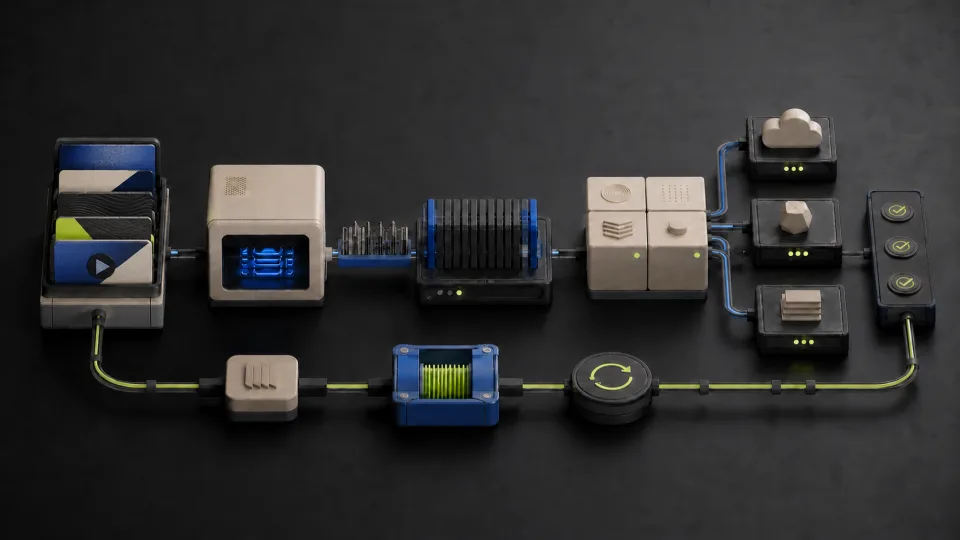
Each platform had a different publishing flow, authentication boundary, limit and verification signal. Rendering could outlive a web request. A successful upload could still become a duplicate after a crash. Analytics could be incomplete. The central product problem was reliable coordination under partial failure.
YouTube, TikTok and Instagram expose different APIs, handoffs, limits and success signals.
An upload response is not the same as verified publication, and a lost remote ID can trigger a duplicate.
Local rendering and media processing do not fit an ephemeral web runtime or a single request lifecycle.
Platform metrics arrive with different completeness, so experiments need explicit primary and secondary signals.
Separate clip and platform states keep one failed handoff from corrupting the status of the full content item. The system persists durable identifiers at the earliest safe point and verifies downstream coverage before declaring completion.
Private product case. The system model and analytics are reconstructed from reviewed local product artifacts; no account credentials, private content or platform secrets are exposed.
Persist the remote video ID immediately after a successful upload, before later steps run, so a crash does not create a second upload.
Keep separate TikTok and Instagram lifecycle states instead of treating a browser or API handoff as universal success.
Stop when the raster, rights state, platform limit or publication evidence is missing rather than guessing and publishing anyway.
Compare expected and observed outputs, then recover missing platform work without repeating completed work.
Attach a hypothesis, primary metric and secondary metric to content tests so the system can change based on evidence, not taste.
A reviewed analytics snapshot contained 313 measured publications. It supported decisions about hook length, spacing, cadence and weighted content rotation. One comparison showed why the product needed a learning layer rather than a fixed schedule.
62.5% success rate and an average of 36.3 views per hour in the reviewed sample.
40.8% success rate and an average of 18.0 views per hour in the reviewed sample.
Analytics informed hook limits, spacing and a weighted rotation rather than producing a passive dashboard.
Platform outcomes are reported as results of the documented system run, not attributed to one isolated design decision.
The subscriber count is the public channel display as of 2 October 2026. Pray Shield is a real operating context for Clip Forge; the channel's overall growth is not attributed solely to the automation system. View Pray Shield on YouTube ↗
For historical comparison, an earlier documented 27-day run recorded 660,118 views and 1,040.1 watch hours while the channel had nearly 28,000 total subscribers. Those figures describe that earlier run, not the current channel totals.
The durable design lesson is that automation quality depends on observability, idempotency, platform-aware limits and recovery. The interface must explain what happened, what is safe to retry and which external dependency owns the next action.