Order to documentation
The product connected ordering, delivery status, verification, quality control, testing and the records required after a pour.
Case 01 / Concrete operations software
At NEXPLORE Technology, part of the HOCHTIEF Group, I led UX for BCQD. I translated construction-site research, business rules and data constraints into coherent workflows released in Germany and the US.
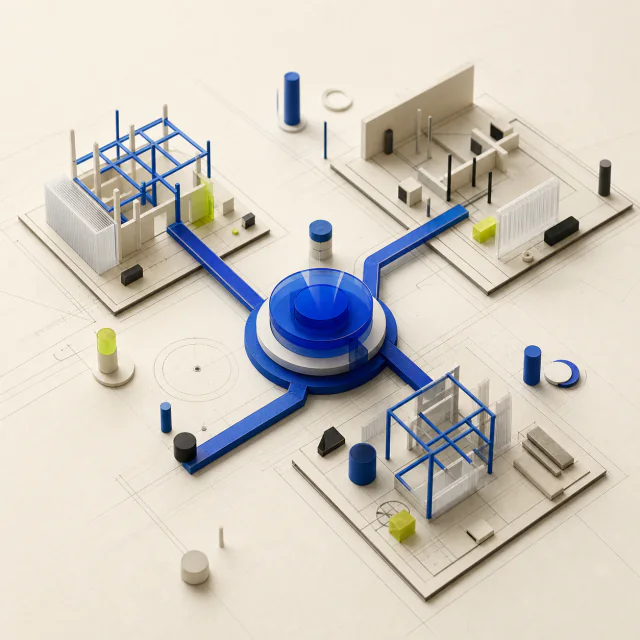
BCQD digitized an existing concrete workflow across order creation, delivery, quality checks, testing and documentation. Construction teams, site users and concrete suppliers needed shared information, while web planning and mobile work on site required different interaction priorities within one coherent product model.
The product connected ordering, delivery status, verification, quality control, testing and the records required after a pour.
Mobile use on construction sites and web-based planning needed one coherent product model with different interaction priorities.
Vocabulary, ordering logic and operational reality could not be simplified away. They had to become understandable product behavior.
The interaction model supported releases in two markets while contributing to a globally aligned UX working method inside Nexplore.
Public context: Nexplore describes its HOCHTIEF Group relationship and lists both HOCHTIEF and Turner among the companies it works with. The signed project evidence documents BCQD releases in Germany and the US, so this case uses the verified markets rather than assigning the product to one specific subsidiary.
I treated the product as a connected operating system, not a set of isolated screens. User evidence had to be reconciled with specialist process knowledge, data mappings, technical feasibility and different interaction contexts across web and mobile.
Real operating behavior and usability analysis anchored the product model.
Specialist knowledge supplied the rules, vocabulary and process reality behind the interface.
Business processes were made explicit before being translated into requirements and interaction flows.
Technical feasibility, data mappings and implementation constraints shaped the chosen direction.
This is an anonymized reconstruction based on documented project responsibilities. It does not reproduce confidential production screens or client data.
Within my UX remit, I worked independently while keeping the product deeply cross-functional. I built the necessary domain knowledge, selected the right artifact for each decision and brought users, process design, business analysis, architecture, operations and engineering into the decision at the right moment.
I made actors, operational goals, rules and constraints explicit before defining interface behavior.
I learned from construction-site users and operational experts, then analyzed, categorized and prioritized the findings.
I translated business processes into user flows, data mappings, wireframes, mockups and interactive prototypes that made tradeoffs discussable.
I worked with software architecture and engineering so the proposed behavior respected implementation constraints and the product vision.
I connected local product decisions to the global design system and transferred the working approach to related products.
The employment evidence explicitly confirms self-directed work, initiative, rapid understanding of complex processes and attention to technical feasibility.
Business processes were complex, domain-specific and spread across web, mobile and a wider product landscape.
How can teams create consistency without forcing every product and operating context into the same screen structure?
Translate the process into shared user flows, data mappings and interaction behavior, then express the proven patterns through the design system.
Preserve domain and product-specific rules while standardizing the parts users should be able to predict across applications.
The working method and interaction language could transfer from the concrete-ordering product to further Nexplore products such as Minerva.
Each artifact reduced a different uncertainty: process fit, information order, interaction behavior, user comprehension, technical feasibility and cross-product consistency.
The role extended beyond handing over static screens. I connected interaction decisions with existing frameworks, platform conventions, data relationships and a changing technical foundation.
Created the initial mobile design around native interaction expectations and the realities of use on site.
Applied and extended component behavior while keeping the specialist workflow understandable.
Supported redesign work during the frontend transition instead of treating migration as an engineering-only concern.
Worked close to data mappings and code so business processes, interface behavior and feasibility remained aligned.
The available employment evidence credits a material contribution to both releases and to a standardized, globally aligned service-design way of working. It also documents transfer of the approach to Minerva. I do not attach an invented adoption, revenue or efficiency metric to that work.
Research, domain learning and business-process translation produced a product model teams could design and build.
Shared process and interaction logic supported web, mobile, the global design system and related products.
The work materially contributed to concrete-ordering releases in Germany and the United States.
Market releases and system transfer are documented. Adoption, revenue and efficiency were not attributed to me in the available evidence.